06 · Hardware · CoreXY
CoreXY 3D Printer
A self-built CoreXY 3D printer — the motion system where two motors jointly drive the X and Y axes through a shared pair of belt loops, rather than one motor per axis.
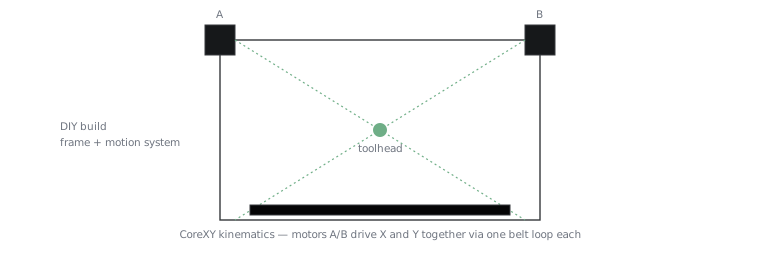
In a CoreXY machine, two stationary motors each drive one continuous belt loop routed through the gantry so that the toolhead's X and Y motion is the combined, decoupled result of both motors moving together — one motor pair moving in the same direction drives one axis, moving in opposite directions drives the other. It trades a slightly more involved belt path for keeping both motors fixed to the frame instead of one riding on a moving gantry, which is the appeal for a first from-scratch build: less mass in motion, and the geometry is the whole design problem.
Why build one instead of buying one
A CoreXY kinematic system is a small, self-contained mechanical-design problem — belt tensioning, pulley alignment, and frame squareness all show up directly as print quality, which makes it a fast feedback loop for the same kind of frame-and-motion-system thinking that shows up in the drag reduction system and linkage torque solver I've worked on at Penn Electric Racing.
I don't have build photos or a bill of materials to publish here yet — this page describes the machine's kinematics rather than documenting the build in detail.