04 · Python · FastAPI · React
Heating Ring Design Automation
锦珂 (GIENKEE) heating-ring design automation: a customer's layout-diagram JSON goes in, and a full production package — BOM, winding programs, sheet-metal DXF — comes out.
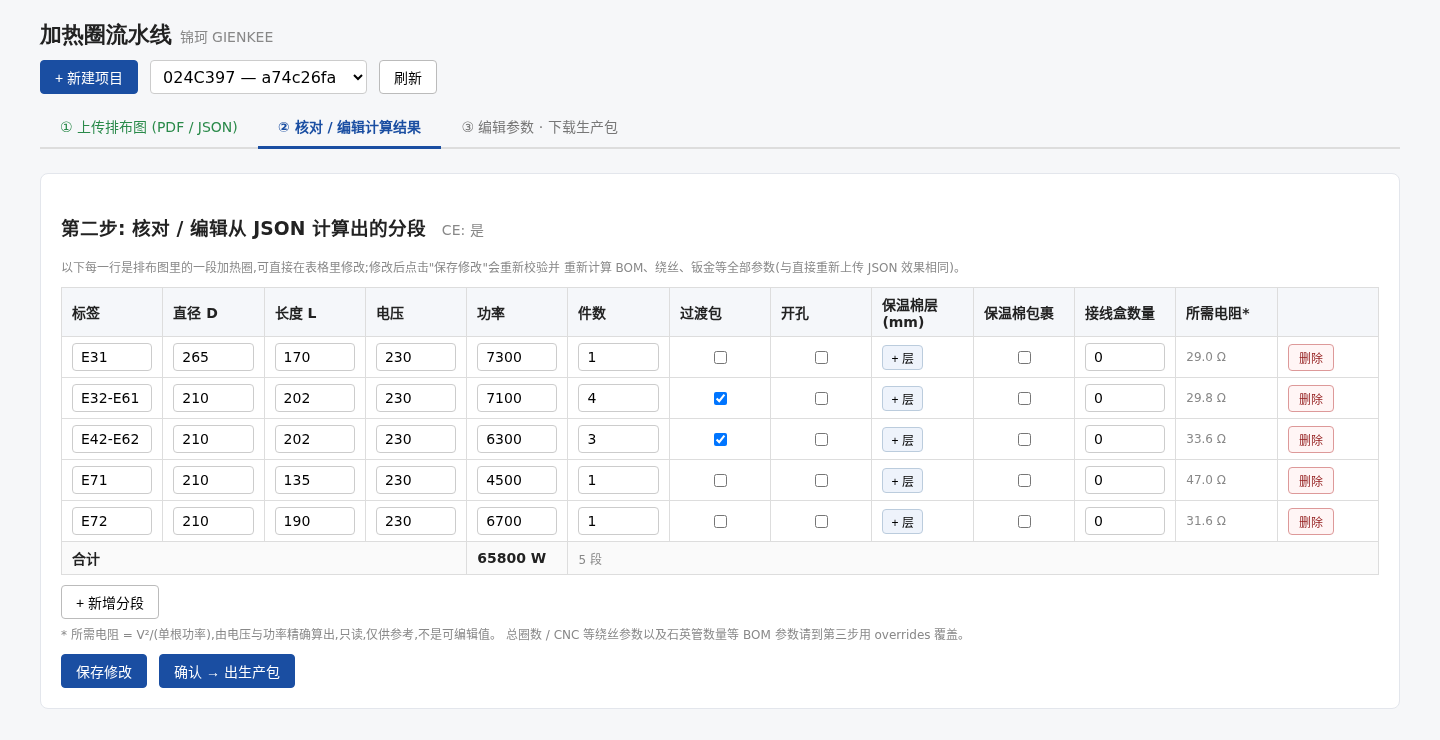
Jinke Energy (brand name GIENKEE / 锦珂) makes heating rings, and every order used to start from a
hand-filled spec sheet. Heating Ring Design Automation is the internal web tool I built to replace
that: a layout-diagram JSON ({machine, specs}) goes in, and everything downstream is
derived through deterministic calculation engines — bill of materials, winding parameters and CNC
winding programs, and sheet-metal DXF — merged into a single production-package PDF plus DXF. It
runs as a three-step wizard (upload spec → review and edit the calculated segments → generate and
download the production package) or a CLI, and the core workflow runs end to end in production
today.
Reading the spec off the customer's own PDF
Customers hand over layout diagrams as PDFs, often scans with no text layer and sometimes
password-protected. A newer ingestion module feeds those PDFs to Gemini for structured extraction,
producing the same {machine, specs} JSON that a hand-filled spec would — so the result
goes through the identical downstream validation and rendering path, with no separate parsing code
to maintain. Every extracted JSON is still checked against the same deterministic schema validator
that hand-filled specs use. Where Gemini isn't confident about a field — a dimension is obscured, or
two layout options are hard to disambiguate — it still fills in a best guess, but records a
{"field": ..., "reason": ...} entry in a top-level _review array. Validation
and rendering never read that array; it exists purely so a person can scan it before trusting the
extraction.
What's deliberately not built yet
The project's own docs are explicit about scope, and I'd rather repeat that here than overstate it:
there's no automated .docx intake for the customer information sheet, no independent
"rules engine" module (the BOM/winding/sheet-metal derivations are deterministic formulas living
directly in their calculation modules), no SolidWorks two-way sync, and no single-file distribution
that skips a Python/Node install. The calculation engine itself has been reverse-derived from one
machine series so far; other series don't have real parameters yet.
Design principles
The calculation engine is pure deterministic formulas with no model inference, fully overridable and fully offline. PDF extraction is the one place an LLM touches the pipeline, and its output is never trusted directly — it's validated the same way a human-entered spec would be, with uncertainty surfaced rather than hidden.